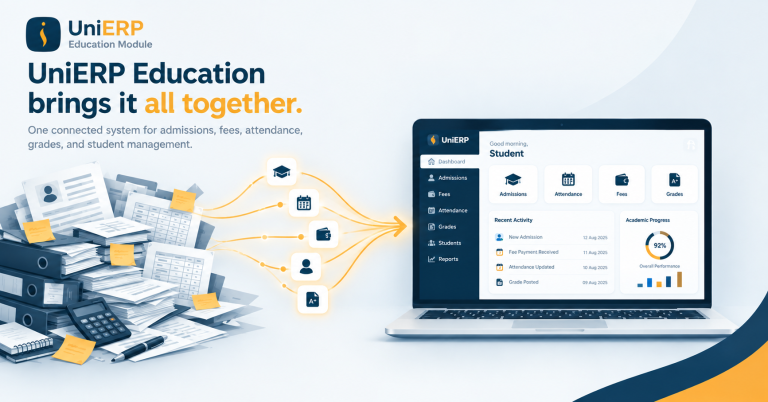
Walk into most school offices, and you’ll find the same scene. A binder of admission forms sits on one shelf. A fee spreadsheet lives on someone’s laptop. Attendance registers fill another drawer entirely. Nobody set out to build it this way it just happened, one urgent workaround at a time.
An education management system exists to undo that. Instead of five disconnected habits, it gives an institute one place where every student record actually connects to the next.
So, this guide walks through exactly how that works, from the first application to the final report card.
What an Education Management System Actually Does
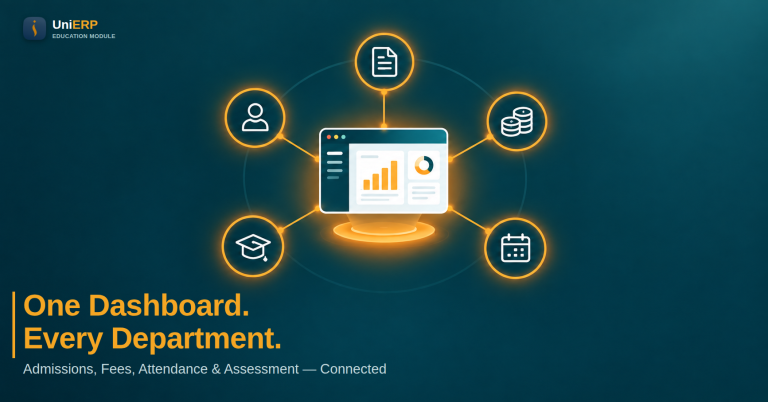
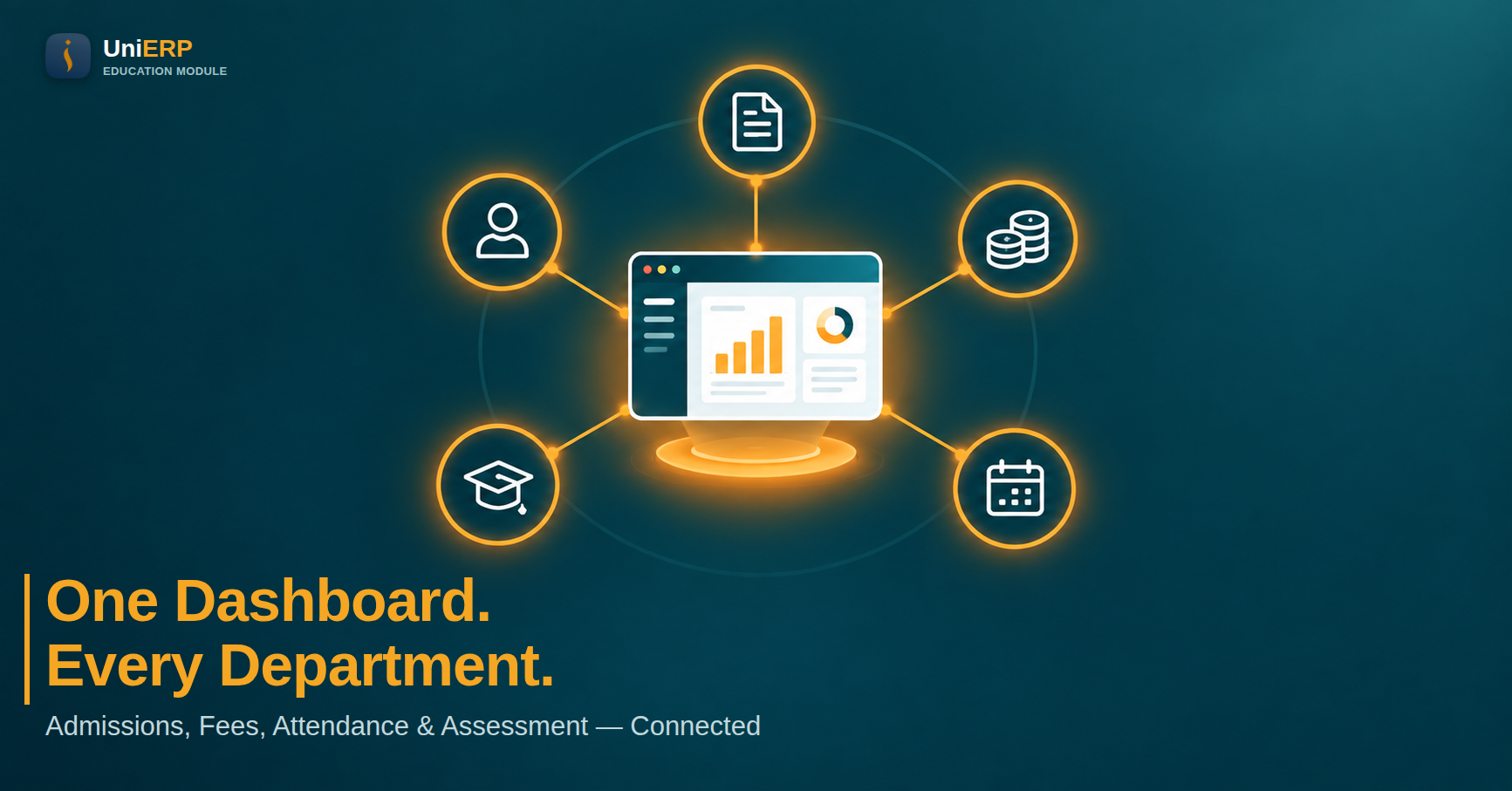
At its core, an education management system links every department to the same underlying data. Admissions, academics, attendance, fees, and reporting all write to one record per student. Because of this, a change in one place shows up everywhere else, instantly.
That single idea changes daily operations more than any single feature does. In fact, a principal no longer has to cross-reference three files just to answer a simple question. The answer is already sitting in one dashboard.
Step One: Admissions, Without the Paper Trail
Every student’s journey starts as an application. In a paper-based office, that application can sit in a drawer for days before anyone reviews it. In a connected system, it becomes a digital Student Applicant record the moment someone submits it whether through a web form or a staff member typing it in directly.
From there, review becomes simple. Staff approve or reject the application with one click. Once approved, a single “Enroll” button does the heavy lifting: it creates the full Student record, links the Guardian, and generates the Program Enrollment, complete with courses already attached.
As a result, nobody retypes the applicant’s name a second time. That alone removes one of the most common sources of admissions errors.
Step Two: Fees That Calculate Themselves
Ask any finance officer what causes the most month-end stress, and fee reconciliation usually tops the list. A modern education management system removes most of that stress by building fees from a template instead of a memory.
First, staff define Fee Categories tuition, technology, activities, whatever the institute charges. Next, they combine those into a Fee Structure, built once per program and academic term. Because that structure already exists, every enrolled student in the program gets billed the same way, automatically.
From there, the system generates an invoice and posts it directly to the ledger. No manual journal entry. No spreadsheet to reconcile against the bank statement later. Discounts for specific student categories a sibling, a scholarship, a reserved-category concession apply automatically too, based on rules set once.
Even paying fees gets simpler parents don’t need an office visit anymore. A portal lets them view their balance and pay online, and the invoice status updates the moment payment clears.
Step Three: Attendance and Assessment, Finally Connected
Meanwhile, attendance and grading usually live in completely separate habits a paper register for one, a personal notebook for the other. An education management system merges them into a single thread.
Attendance links to the exact class it belongs to, not just a generic day. If a student applies for leave and staff approve it, the system automatically marks the correct attendance status. Nobody adjusts the record twice.
Assessment follows a clear structure, too. Staff first define Assessment Criteria the specific things being measured. They group exams under an Assessment Group, such as a semester or a unit test. A Grading Scale then converts raw scores into final letter grades.
Because this structure exists before any exam happens, entering results later takes minutes, not hours. A teacher selects the Assessment Plan, and the system already knows which students, which criteria, and which scale apply. By the end of term, the report card has mostly built itself it’s simply a summary of data the system already captured.
Step Four: One Portal, Every Stakeholder
However, none of this matters if the information stays locked inside a staff-only system. That’s why a student portal matters just as much as the back-office workflow.
Students and guardians log in to see the live timetable, current attendance, fee status, and grades the same numbers staff are looking at, updated in real time. Parents stop calling the office just to ask a status question. Staff stop fielding the same question five times a day.
Step Five: Reports That Answer Instantly
Of course, a spreadsheet can tell you what happened last week if someone remembered to update it. A connected education management system tells you what’s happening right now.
Ask how many students are behind on fees this term, and the answer comes from live invoice data, not a manually maintained tracker. Ask which students have fallen below an attendance threshold, and the report pulls directly from daily records, not a register someone forgot to scan. That immediacy is the real difference between managing an institute and simply documenting it after the fact.
Built on a Platform the World Already Trusts
Importantly, none of this runs on custom, unproven code. UniERP for Education is built on the Frappe Framework and ERPNext, the same open-source ERP engine already trusted worldwide. Today, that same engine runs accounting, inventory, and manufacturing operations for organizations across the globe.
That foundation matters for two reasons. First, it’s field-tested at scale, not a first attempt. Second, it stays flexible enough to configure around how your institute actually works, instead of forcing your institute to work around rigid software.
Why Institutes Choose UniERP
Unicress Solutions has been building on this platform since 2004. Its engineering, delivery, and support teams now span the US, the GCC, and Pakistan the same global team behind UniERP’s manufacturing and trading implementations, now applied to education.
That experience shows up in the details: an admissions flow that doesn’t require retyping, a fee engine that reconciles itself, and an assessment structure that turns grading into a five-minute task instead of a weekend one.
So if your institute still runs on five disconnected habits, it might be time for one system that already agrees with itself.
Book a free demo of UniERP for Education →www.unierp.io