A wholesaler doesn’t lose money because they don’t have stock. They lose money because they don’t know what stock they actually have or where it is.A product sits in the wrong warehouse. A sales rep promises delivery on something that’s already sold out. A customer calls about an order, and nobody can say for certain whether it shipped. None of this happens because the business lacks inventory. It happens because nobody can see it clearly, in one place, in real time.
This is exactly the gap distribution ERP software closes. Let’s look at where that visibility breaks down, and what a connected distribution system actually fixes.
The Problem: Stock Exists, But Nobody Can See It Clearly
Most distribution businesses run on a mix of tools. One spreadsheet tracks the main warehouse. A different one tracks the regional outlet. Sales reps note commitments in a notebook or a WhatsApp message. Each piece of the picture exists somewhere just not in the same place, and rarely up to date at the same moment.
Here’s what this usually looks like day to day:
- Multiple warehouses, no single view. Stock sits across a main warehouse, regional locations, and outlets, but nobody can check total available quantity without calling around.
- Sales reps oversell. A rep confirms an order without knowing that another branch just sold the last units.
- Reordering happens too late, or too early. Without a clear signal for low stock, purchasing either waits until a customer complains or orders more than the business actually needs.
- Returns and damaged stock go untracked. Products come back, but nobody updates the real count — so the “available” number on paper never quite matches what’s actually on the shelf.
- Margins stay unclear per customer or route. Pricing, discounts, and payment terms often vary by customer, but tracking real profitability per account takes a manual reconciliation nobody has time for.
Why This Costs More Than It Looks Like
A distributor who can’t see their stock doesn’t just lose the occasional sale. They lose trust. A customer who gets told “we’re out of stock” on something that’s actually sitting in a warehouse two branches away doesn’t blame the warehouse they blame the business.
And the reverse costs money too. Overordering to “play it safe” ties up cash in stock that sits unsold for months, in a warehouse that could be holding something that actually moves.
Distribution ERP software solves this by giving every part of the business purchasing, warehouse, sales, and finance the same real-time picture of stock, instead of five different guesses.
What a Connected Distribution System Actually Looks Like
A proper distribution ERP centers on a few core building blocks that keep every location in sync:
One Item Master, Every Location
Every product exists as a single master record — with its code, pricing, and unit of measure defined once. Every warehouse references the same record, so “Item A” means exactly the same thing whether it’s sitting in the main store or a regional outlet.
Warehouses You Can Actually See Into
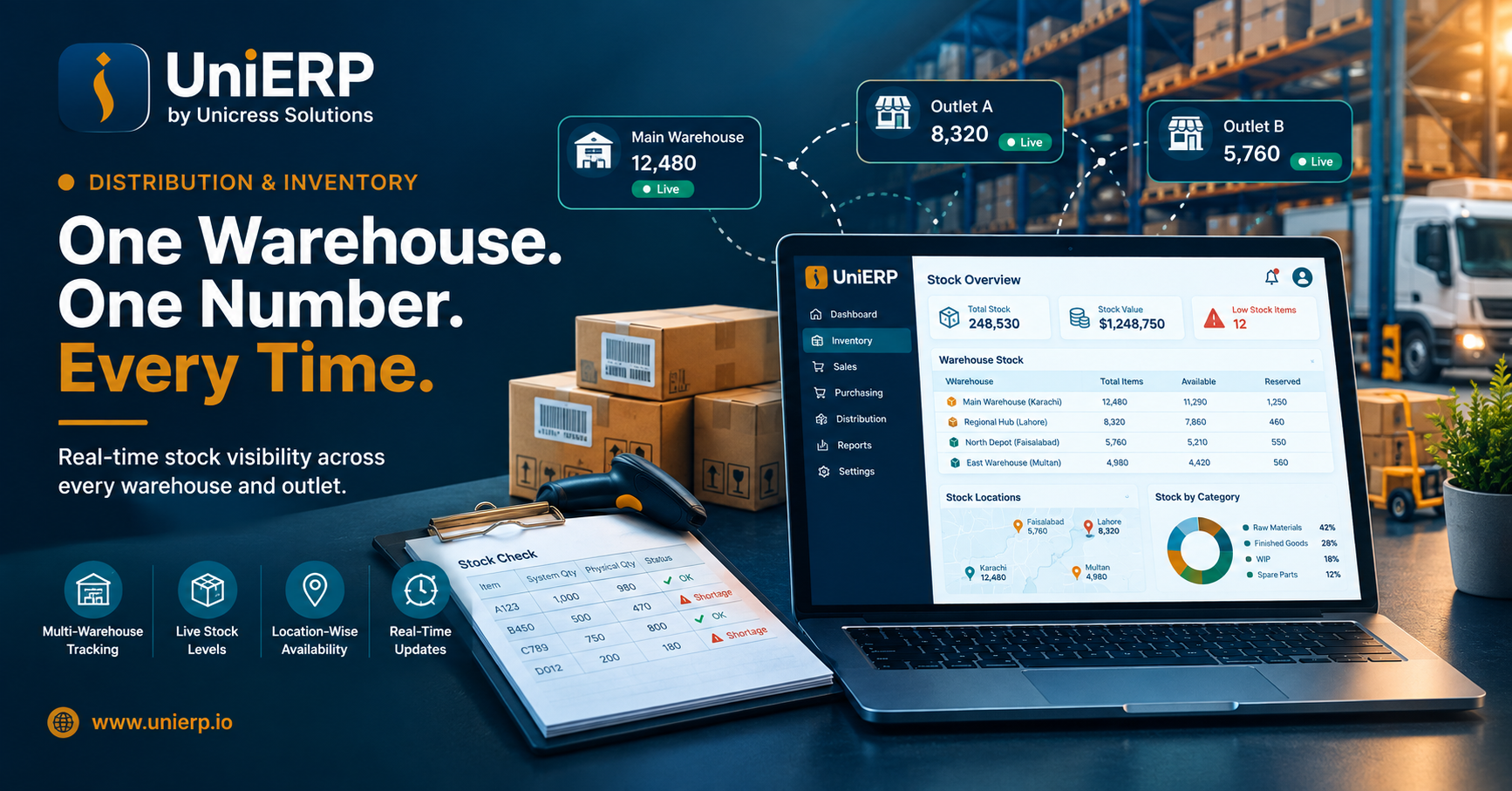
Each location main warehouse, regional warehouse, or retail outlet shows its own real stock count, and the system rolls all of them up into one total view. A sales rep checking availability sees the real number, not a guess.
Automatic Material Requests
When stock in a warehouse drops below a set level, the system creates a material request automatically. Purchasing doesn’t have to watch spreadsheets or wait for a phone call the reorder signal comes from actual stock movement.
Customer & Supplier Records That Actually Connect
Customer pricing, payment terms, and order history live in one place, tied to every transaction. The same goes for suppliers so procurement decisions come from real purchase history, not memory.
Sales, Warehouse, and Finance Same Numbers
When an order gets placed, it checks against real stock, updates the warehouse automatically, and flows straight into the invoice. Nobody re-enters the same information three times across three departments.
Who Feels This Problem Most
A few signs suggest your distribution business still runs on scattered visibility:
- Sales reps promise stock they can’t actually confirm is available.
- Nobody can answer “how much of this do we have, across all locations?” without calling multiple people.
- Reordering happens reactively after a stockout, not before one.
- Customer profitability is a guess, not a number anyone can pull up.
If this sounds familiar, more spreadsheets won’t fix it. Connecting the warehouses, sales, and purchasing into one system will
Final Thoughts
A distribution business runs on movement stock moving in, stock moving out, constantly. When that movement isn’t visible in real time, every department ends up working from a slightly different, slightly outdated picture.
UniERP Distribution connects purchasing, warehouses, sales, and finance into one system, so the stock number everyone sees is the real one not last week’s estimate.
Ready to see what real-time distribution visibility looks like? Book a free demo at unierp.io and put your entire supply chain on one screen.