

In today’s fast-moving digital world, businesses must operate smarter, faster, and more efficiently than ever before. Managing multiple departments, tracking finances, monitoring inventory, and handling customer data manually can slow growth and increase costly errors. This is where ERP software becomes a powerful solution.
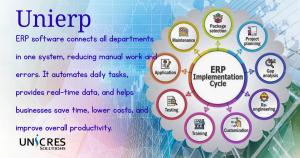
Enterprise Resource Planning (ERP) software integrates all core business functions into one centralized system. From finance and HR to sales and supply chain, ERP creates a unified platform that helps organizations streamline operations and improve overall efficiency.
In this blog, we’ll explore how ERP software improves business efficiency, why it’s essential for growth, and how it transforms the way companies operate.
What is ERP ?
ERP (Enterprise Resource Planning) software is an integrated management system that connects different business processes into a single platform. Instead of using separate tools for accounting, inventory, HR, and customer management, ERP combines everything into one system.
This centralized approach eliminates data silos and ensures that all departments work with accurate, real-time information.
Why Business Efficiency Matters
Business efficiency is about achieving maximum output with minimal waste of time, money, and resources. Efficient businesses:
Reduce operational costs
Improve employee productivity
Deliver better customer service
Make faster and smarter decisions
Scale operations smoothly
Without proper systems in place, businesses often struggle with duplicate work, manual errors, delayed reporting, and communication gaps. ERP software solves these challenges.
1. Centralized Data Management
One of the biggest advantages of ERP software is centralized data storage.
Instead of keeping information in multiple spreadsheets or disconnected systems, ERP stores everything in one database. This means:
No duplicate data entry
Reduced human errors
Real-time access to updated information
Better collaboration between departments
For example, when the sales team closes a deal, the finance department automatically receives the billing information. The inventory team can also see stock updates instantly. This seamless flow of information improves coordination and saves time.
2. Automation of Routine Tasks
Manual tasks consume valuable time and increase the risk of errors. ERP software automates many daily business processes, such as:
Invoice generation
Payroll processing
Inventory updates
Order tracking
Report generation
Automation reduces repetitive work and allows employees to focus on strategic activities instead of administrative tasks. This significantly boosts overall productivity.
3. Improved Decision-Making with Real-Time Data
Data-driven decisions are essential for business growth. ERP systems provide real-time dashboards, reports, and analytics that help managers understand performance instantly.
With accurate insights, businesses can:
Monitor sales trends
Track expenses
Identify profitable products
Forecast demand
Plan budgets effectively
Instead of waiting days or weeks for manual reports, decision-makers can access information instantly and respond quickly to market changes.
4. Better Financial Management
Financial control is the backbone of any successful business. ERP software improves financial efficiency by:
Tracking income and expenses
Managing accounts payable and receivable
Automating tax calculations
Generating financial statements
Reducing accounting errors
With a unified financial system, businesses gain better transparency and control over their cash flow. This leads to improved budgeting and financial planning.
5. Enhanced Inventory and Supply Chain Management
Poor inventory management leads to stock shortages or excess inventory, both of which impact profitability.
ERP helps businesses:
Track inventory in real time
Monitor stock levels
Manage suppliers
Optimize warehouse operations
Reduce waste and storage costs
Accurate inventory management ensures that businesses always have the right products at the right time, improving customer satisfaction and operational efficiency.
6. Streamlined Human Resource Management
Managing employees manually can be time-consuming and complicated. ERP software simplifies HR operations by:
Managing employee records
Automating payroll
Tracking attendance
Handling recruitment processes
Monitoring performance
With automated HR systems, companies can save time and maintain accurate employee data, which improves workforce management.
7. Improved Customer Service
Customer satisfaction is directly linked to business efficiency. ERP software enhances customer service by:
Providing complete customer history
Tracking orders and deliveries
Managing support tickets
Reducing response time
When teams have instant access to customer information, they can respond quickly and provide better service. Happy customers lead to repeat business and long-term growth.
8. Reduced Operational Costs
By eliminating manual work, reducing errors, and optimizing processes, ERP software lowers operational expenses.
Businesses save money through:
Less paperwork
Fewer data entry mistakes
Reduced overtime
Better resource utilization
Efficient procurement processes
Over time, the return on investment (ROI) of ERP software becomes significant.
9. Scalability for Growing Businesses
As businesses expand, their operations become more complex. Managing growth without a proper system can create confusion and inefficiency.
ERP software supports scalability by:
Handling increased transactions
Managing multiple branches
Supporting more users
Adapting to new business processes
This makes ERP an ideal solution for small, medium, and large enterprises planning long-term growth.
10. Improved Collaboration Across Departments
When departments work in isolation, productivity suffers. ERP breaks down communication barriers by allowing teams to share information easily.
For example:
Sales can see inventory availability
Finance can monitor sales performance
Management can track overall company metrics
This integrated approach improves teamwork and reduces misunderstandings.
Real-World Example of ERP Efficiency
Imagine a manufacturing company that manages orders manually. Sales records orders in spreadsheets, finance creates invoices separately, and inventory updates stock manually. This creates delays and errors.
After implementing ERP software:
Orders are entered once
Inventory updates automatically
Invoices are generated instantly
Management receives real-time performance reports
The result? Faster operations, fewer mistakes, and higher profits.
Key Industries That Benefit from ERP
ERP software improves efficiency in various industries, including:
Manufacturing
Retail
Healthcare
Construction
Distribution
Education
Service-based businesses
Regardless of industry, any organization managing multiple processes can benefit from ERP.
How to Choose the Right ERP Software
To maximize efficiency, businesses should choose ERP software that:
Matches industry requirements
Offers customization options
Provides real-time reporting
Supports cloud access
Ensures data security
Is scalable for future growth
Investing in the right ERP system ensures long-term success and improved operational performance.
Final Thoughts
ERP software is no longer a luxury—it is a necessity for modern businesses aiming to stay competitive. By integrating departments, automating processes, and providing real-time insights, ERP significantly improves business efficiency.
From reducing costs to enhancing customer service, the benefits of ERP are clear. Companies that implement ERP systems position themselves for sustainable growth, improved productivity, and smarter decision-making.
If your business is still relying on manual systems or disconnected tools, now is the right time to consider ERP software. The sooner you implement it, the faster you’ll experience increased efficiency and stronger business performance.