Ask most factory owners what a product costs to make, and you’ll get a fast answer. Ask them what it really costs material, labour, overhead, scrap, all of it. The honest answer is usually: “we’ll know in a few weeks.”
That gap between “estimated cost” and “actual cost” is exactly what manufacturing cost accounting software closes. Here’s why the gap exists, and what it takes to close it.
The Problem: Costing Happens in Pieces, Not in Real Time
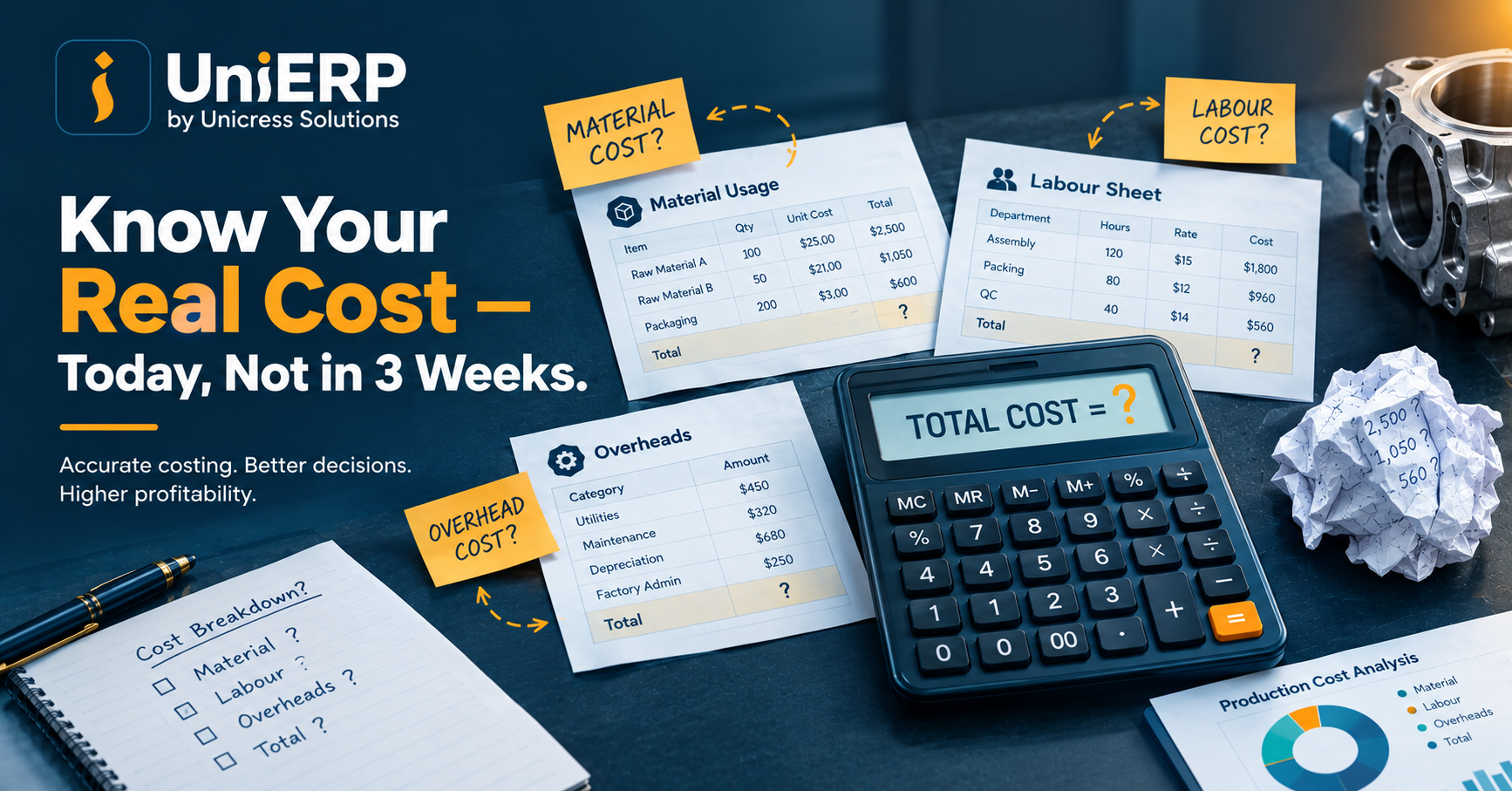
Production cost isn’t one number. It’s several numbers that live in different places. A stock report holds material usage. A separate sheet, department by department, holds labour hours. Someone estimates overhead electricity, maintenance, indirect labour separately, often as one lump sum split across everything the factory made that month.Nobody adds these numbers together until it’s time to close the books. By then, that production run has long since ended.
Here’s what this usually looks like in practice:
- Material cost stays untied to a specific job. You know what raw material the whole month used, but not necessarily what a single work order actually consumed.
- Payroll calculates labour cost separately from production. It logs hours worked, but doesn’t always allocate them back to the batch they produced.
- Factories guess overhead instead of allocating it. Electricity and maintenance costs get spread evenly across everything, even though some products genuinely cost more to make than others.
- The final number arrives weeks later, often as part of a month-end close. By then, you’ve already priced that product.
Why “Close Enough” Costing Is a Real Problem
Pricing a product without knowing its true cost isn’t a small inefficiency. It’s a decision you make with incomplete information and you repeat it every time a quote goes out. A product can look profitable on a rough estimate. Once real overhead and scrap enter the picture, it can quietly lose money instead. You won’t know until the numbers catch up, usually a month or two later.
This is the core promise of manufacturing cost accounting software: it captures cost data as production happens, instead of assembling it after the fact. That way, “true cost” and “estimated cost” become the same number.
What Real-Time Cost Accounting Actually Looks Like
A connected manufacturing ERP ties cost accounting directly to the shop floor, not just to the finance department. That means:
Material Cost, Tied to the Job
When raw material goes out to a specific work order, the system records that consumption against that job. It doesn’t just deduct it from general stock. It knows exactly what a specific batch used, not an average.
Labour Cost, Tied to the Job Card
As workers complete job cards, that recorded labour time feeds straight into the cost of that production run. Nobody has to reconcile it separately during payroll processing later.
Scrap Costed at the Source
When scrap or rework happens, the system captures it at the job card level, right where it occurs. That means unit margins reflect what production actually wasted, not a rough monthly average spread across everything.
Landed Cost, Not Just Purchase Price
Many businesses treat freight, customs duties, and handling fees as a separate “overhead” line instead of adding them to the actual material cost. A connected system allocates these landed costs back to the raw material itself, so the true input cost stays accurate from the start.
Cost-Center Accounting
For manufacturers running multiple lines or plants, cost-center accounting tracks costs per line or facility. That makes it clear which part of the operation actually drives margin and which one quietly eats into it.
Who Feels This Problem Most
A few signs suggest your costing still runs on estimates, not real numbers:
- Your product pricing relies on a cost figure from months ago, not today’s.
- Nobody can answer “what did this specific batch actually cost to produce?” without a manual calculation.
- You track scrap and rework in total, not tied to specific jobs or causes.
- Month-end reports show you the real production cost for the first time.
If this sounds familiar, the fix isn’t a better spreadsheet. It’s connecting cost accounting to the same system that runs production.
Final Thoughts
A manufacturing business without real-time costing isn’t exactly running blind it’s running on a delay. Every pricing decision, every quote, every margin review relies on numbers that are already a few weeks old.
UniERP ties material usage, labour, scrap, and overhead directly to production as it happens. The cost you see is the cost that actually occurred not an estimate you’ll correct later.
Ready to see what real-time manufacturing cost accounting looks like? Book a free demo at unierp.io and put your true margins on one screen.