
Every NGO starts with a clear mission. What gets harder over time isn’t the mission — it’s proving, clearly and consistently, that every rupee, dollar, or grant went exactly where it was supposed to.
That’s not a compliance problem. It’s an opportunity most NGOs haven’t fully unlocked yet — and it’s exactly what good NGO management software is built to solve.
Where most NGOs already do well and where the gap sits
NGOs are usually excellent at the mission-critical work: running programs, coordinating field teams, delivering aid, managing volunteers. That part rarely needs fixing.
The gap tends to sit one layer up in how that work gets recorded, tracked, and reported back to donors, boards, and regulators:
- Donor funds and general operating funds tracked in the same place, making it hard to show restricted vs. unrestricted spending clearly
- Grant reporting pulled together manually, program by program, right before a deadline
- Volunteer and field data sitting separately from the financial picture
- Board and donor reports that take days to assemble instead of minutes to generate
None of this reflects poorly on the team. It’s simply what happens when an NGO’s operations grow faster than the systems tracking them and it’s a genuinely solvable gap.
What good NGO management software actually changes
The right system doesn’t ask your program teams to work differently. It gives your finance and leadership teams a clear, real-time view of everything already happening:
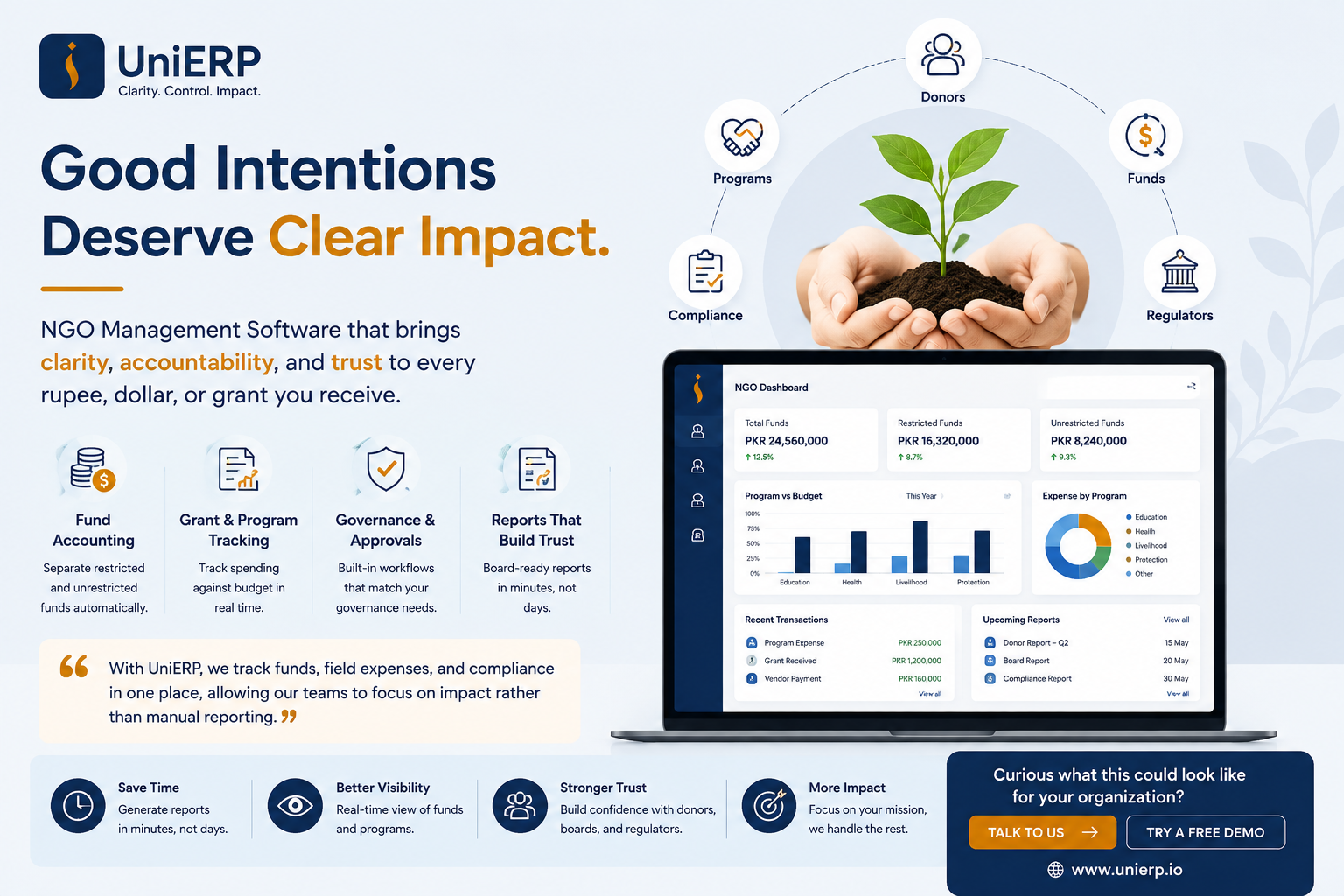
- Fund accounting that clearly separates restricted and unrestricted funds, by design
- Grant and program tracking, so spend-against-budget is visible at any point, not just at reporting time
- Governance and approval workflows, matched to how your board and donors actually expect decisions to be made
- One reporting layer, pulling program, financial, and donor data into reports that are ready when you need them not assembled under deadline pressure
A real example of this in practice
We worked with PIHRO, and their chairman, Habib Malik Orakzai, described what changed clearly:
With UniERP, we track funds, field expenses, and compliance in one place, allowing our teams to focus on impact rather than manual reporting.
That’s the heart of it. Not more paperwork. Not more oversight for its own sake. Just clear structure that makes good governance easier to demonstrate to your board, your donors, and your regulators.
Why this matters more for NGOs specifically
Nonprofit operations carry a layer of complexity most commercial businesses don’t: multiple funding sources with different restrictions, program-level accountability, and reporting obligations to donors and regulators alike. Generic business software wasn’t built with that structure in mind it asks nonprofit operations to bend around commercial logic.
Purpose-built NGO management software takes the opposite approach: it’s built around how nonprofit governance actually works, so your systems support your mission instead of adding friction to it.
What this looks like day to day
- Restricted and unrestricted funds tracked separately, automatically
- Grant spending visible against budget in real time
- Board-ready financial reports generated in minutes, not days
- One accurate picture shared across program, finance, and leadership teams
The bigger picture
NGOs don’t need to work harder to build donor trust and regulatory confidence they need systems that make the good work they’re already doing easy to see, easy to report, and easy to trust.
That’s what NGO management software is meant to deliver: clarity that lets your mission speak for itself.
Curious what this could look like for your organization? Talk to us or try a free demo.