Healthcare organizations face a complex challenge when selecting the right healthcare ERP software to streamline operations and improve patient care. For hospital administrators, IT directors, and healthcare executives evaluating ERP for healthcare organizations, the wrong choice can lead to costly implementation failures and operational disruptions.
This guide walks you through choosing healthcare ERP system solutions that align with your organization’s unique needs. We’ll explore how to assess your specific requirements and evaluate system integration capabilities that connect seamlessly with existing healthcare IT systems. You’ll also learn to analyze total cost of ownership beyond the initial price tag and examine vendor expertise in healthcare enterprise resource planning implementations.
By the end, you’ll have a clear framework for healthcare software selection criteria that ensures your ERP investment delivers lasting value for your organization.
Understand Your Organization’s Specific ERP Requirements

Assess Current Healthcare Workflow Inefficiencies and Pain Points
Start by taking a hard look at where your organization struggles daily. Walk through your departments and talk to staff about the bottlenecks that slow them down. Patient registration taking too long? Billing errors causing payment delays? Medical records scattered across different systems? These pain points reveal exactly what your healthcare ERP software needs to fix.
Document everything – from how long it takes to process a patient admission to how many steps nurses need to access medication histories. Pay special attention to manual workarounds your staff has created. These shortcuts often highlight where current systems fall short and where a new ERP for healthcare organizations could make the biggest impact.
Don’t forget about the less obvious issues. Maybe your lab results take hours to reach physicians, or your inventory management leads to frequent stockouts of critical supplies. These workflow inefficiencies directly affect patient care quality and operational costs.
Identify Department-Specific Needs and Integration Challenges
Each department in your healthcare facility operates differently, but they all need to work together seamlessly. Emergency departments need instant access to patient histories, while billing departments require detailed procedure codes and insurance information. Your pharmacy needs real-time inventory tracking, and your lab needs to share results immediately with ordering physicians.
Map out how information flows between departments right now. Where do handoffs break down? Which departments can’t easily share data? These integration challenges become your must-have requirements list when choosing healthcare ERP system options.
Consider unique needs too. Surgical departments might need specialized scheduling tools, while outpatient clinics need different patient flow management than inpatient units. Mental health services have distinct documentation requirements compared to cardiology units.
Define Scalability Requirements for Future Growth
Your healthcare organization won’t stay the same size forever. Maybe you’re planning to add new locations, expand services, or merge with another facility. Your healthcare enterprise resource planning system needs to grow with you without requiring a complete overhaul.
Think about patient volume projections for the next five years. Will you double your capacity? Add specialized services like oncology or cardiac care? Each expansion brings new data management needs and user requirements that your ERP must handle.
Consider technology changes too. Telemedicine integration, remote patient monitoring, and AI-powered diagnostics are becoming standard. Your system should adapt to these innovations without forcing you to start over with a completely new platform.
Evaluate Regulatory Compliance and Security Standards Needed
Healthcare faces some of the strictest regulatory requirements in any industry. HIPAA compliance isn’t optional – it’s the baseline. Your healthcare ERP must protect patient data with enterprise-grade security features including encryption, access controls, and audit trails.
Beyond HIPAA, consider other regulations affecting your organization. Joint Commission standards, FDA requirements for medical devices, state licensing board mandates, and Medicare/Medicaid billing rules all create compliance obligations your ERP must support.
Security goes deeper than just regulatory checkboxes. You need systems that can prevent data breaches, detect unauthorized access attempts, and maintain detailed logs of who accessed what information when. With cyber attacks targeting healthcare organizations more frequently, robust security features aren’t just nice to have – they’re essential for protecting your patients and your organization’s reputation.
Evaluate System Integration and Interoperability Capabilities

Ensure seamless connection with existing medical devices and systems
Modern healthcare organizations rely on dozens of interconnected devices and systems to deliver patient care. Your healthcare ERP software must act as a central hub that communicates effectively with everything from patient monitoring systems to laboratory equipment and imaging devices.
Start by creating a comprehensive inventory of all your current medical technologies. This includes bedside monitors, infusion pumps, diagnostic equipment, laboratory analyzers, and any specialized devices unique to your facility. The chosen ERP for healthcare organizations should support standard healthcare communication protocols like HL7 FHIR, DICOM, and IHE profiles.
Look for vendors who demonstrate proven integration capabilities with major medical device manufacturers. Ask potential ERP vendors for specific case studies showing successful connections with devices similar to yours. A quality healthcare enterprise resource planning system will offer pre-built connectors for common equipment brands, reducing implementation time and costs.
Real-time data flow becomes critical when lives are at stake. Your ERP system should capture and process device data instantly, triggering alerts when needed. For example, when a patient’s vital signs change dramatically, the system should immediately update nursing schedules and notify appropriate staff members.
Verify compatibility with electronic health record platforms
Electronic health record compatibility represents one of the most crucial aspects of healthcare ERP selection. Your ERP and EHR systems must work together seamlessly to create a unified patient care environment.
Most healthcare facilities already have established EHR platforms like Epic, Cerner, or AllScripts. Your new healthcare ERP system needs to exchange patient data, billing information, and operational metrics with these platforms without creating data silos or requiring duplicate data entry.
Examine the vendor’s track record with your specific EHR platform. Request demonstrations showing actual data transfers between their ERP and your current EHR system. Pay attention to how patient demographics, insurance information, treatment histories, and billing codes move between systems.
Data synchronization timing matters significantly in healthcare settings. Some integrations update in real-time, while others batch process updates hourly or daily. Real-time synchronization works better for patient safety and operational efficiency, though it may require more robust IT infrastructure.
Consider how the integration handles data conflicts. When patient information differs between systems, the ERP should have clear protocols for resolving discrepancies and maintaining data integrity across all platforms.
Assess API availability for third-party software integration
Modern hospital ERP selection requires evaluating the system’s ability to connect with specialized software applications your organization uses or plans to adopt. APIs (Application Programming Interfaces) serve as the digital bridges that allow different software programs to communicate and share information.
Strong API capabilities give your organization flexibility to choose best-in-class solutions for specific departments while maintaining overall system cohesion. For instance, your radiology department might prefer specialized imaging software, while your pharmacy needs advanced medication management tools.
| Integration Type | Benefits | Considerations |
|---|---|---|
| RESTful APIs | Modern, flexible, easy to maintain | Requires technical expertise |
| SOAP APIs | Reliable, established standards | More complex implementation |
| Custom APIs | Tailored to specific needs | Higher development costs |
Request detailed API documentation from potential vendors. Well-documented APIs indicate a vendor’s commitment to supporting integrations and ongoing system evolution. The documentation should include code examples, authentication methods, and data format specifications.
Test the vendor’s API responsiveness and support quality. Submit technical questions about specific integration scenarios and evaluate how quickly and thoroughly they respond. This preview shows how they’ll support your IT team during implementation and ongoing operations.
Consider future-proofing your healthcare IT systems integration by choosing vendors who regularly update their APIs and support emerging healthcare technology standards. The healthcare technology landscape evolves rapidly, and your ERP system should adapt to new innovations without requiring complete system replacements.
Analyze Total Cost of Ownership and Budget Considerations

Calculate upfront licensing and implementation costs
When selecting healthcare ERP software, understanding the initial financial commitment is crucial for your organization’s budget planning. Licensing costs vary significantly between vendors and deployment models. Traditional perpetual licenses require substantial upfront payments, often ranging from $50,000 to $500,000 depending on your organization’s size and module requirements. Subscription-based models spread costs over time but may total more over the long term.
Implementation costs frequently exceed licensing fees. Professional services for system configuration, data migration, and customization typically cost 1.5 to 3 times the software license price. A mid-sized hospital might spend $200,000 on licensing and another $400,000 on implementation services. These expenses include project management, technical consulting, and specialized healthcare workflows setup.
Don’t overlook hardware infrastructure requirements for on-premise deployments. Server hardware, storage systems, and networking equipment can add $100,000 to $300,000 to your initial investment. Factor in backup systems and disaster recovery infrastructure to protect critical patient data and maintain compliance with healthcare regulations.
Factor in ongoing maintenance and support expenses
Annual maintenance fees represent a significant portion of your total cost of ownership for healthcare enterprise resource planning systems. Most vendors charge 18-25% of the initial license cost annually for software updates, bug fixes, and technical support. A $300,000 license investment translates to $54,000-$75,000 yearly in maintenance costs.
Support quality varies dramatically between ERP vendors. Some provide 24/7 healthcare-specific support with guaranteed response times for critical issues, while others offer basic business-hours assistance. Premium support packages may cost an additional 5-10% but prove invaluable when system downtime affects patient care.
Cloud-based healthcare ERP solutions bundle maintenance into monthly or annual subscription fees, eliminating separate maintenance contracts. However, examine what’s included in these fees. Some vendors charge extra for major version upgrades, advanced reporting tools, or additional user accounts beyond the base package.
Estimate training and change management investments
Staff training represents one of the most underestimated costs in ERP for healthcare organizations. Comprehensive training programs cost $1,000 to $3,000 per user for complex healthcare modules. A 200-user hospital could spend $200,000 to $600,000 on initial training alone.
Change management extends beyond basic software training. Healthcare staff need time to adapt workflows, learn new processes, and maintain productivity during the transition period. Budget for temporary staffing or overtime costs during the learning curve, typically lasting 3-6 months post-implementation.
Ongoing training costs continue throughout the system’s lifecycle. New employees need training, software updates require refresher sessions, and advanced feature adoption drives additional education needs. Plan for annual training budgets of 10-15% of your initial training investment to maintain system proficiency across your organization.
Compare cloud-based versus on-premise deployment costs
| Cost Category | Cloud-Based | On-Premise |
|---|---|---|
| Initial Investment | Lower ($50K-$150K) | Higher ($200K-$500K) |
| Monthly Costs | $500-$2000/month | Minimal after setup |
| IT Staffing | Reduced requirements | Full-time IT staff needed |
| Upgrades | Included in subscription | Additional project costs |
| Scalability | Pay-as-you-grow | Large upfront capacity investment |
Cloud deployments reduce upfront capital expenditure but create ongoing operational expenses. Monthly subscription costs for medical ERP implementation range from $100-$300 per user, depending on functionality and support levels. A 100-user organization might pay $10,000-$30,000 monthly for a comprehensive cloud solution.
On-premise solutions require significant initial investment but offer lower long-term costs for stable organizations. You’ll need dedicated IT staff for system administration, security management, and routine maintenance. Factor in $80,000-$120,000 annually for a full-time healthcare IT administrator plus infrastructure costs like electricity, cooling, and physical security.
Cloud solutions provide automatic updates and disaster recovery, eliminating the need for backup systems and reducing IT complexity. On-premise deployments give you complete control over data and customizations but require expertise in healthcare compliance, security protocols, and system optimization.
Examine Vendor Reputation and Healthcare Industry Expertise

Research Vendor’s Track Record with Healthcare Organizations
When evaluating a healthcare ERP vendor, dig deep into their portfolio of healthcare clients. Look for vendors who have successfully implemented ERP systems in organizations similar to yours – whether you’re a small clinic, multi-specialty practice, or large hospital network. A vendor’s experience with healthcare organizations matters because they understand the unique workflows, regulatory requirements, and operational challenges that define the industry.
Ask potential vendors for case studies and references from healthcare clients. Don’t just settle for testimonials on their website; request direct contact with current customers who can share honest feedback about their implementation experience and ongoing support. Pay attention to how long these healthcare organizations have been using the vendor’s system and whether they’ve expanded their use over time.
The best healthcare ERP vendors will have dedicated healthcare divisions or teams that specialize in medical practice management, patient data handling, and healthcare compliance. They should be able to demonstrate their understanding of healthcare revenue cycles, clinical workflows, and the integration challenges common in medical environments.
Evaluate Customer Support Quality and Response Times
Healthcare organizations can’t afford downtime when it comes to their ERP systems. Patient care, billing processes, and regulatory compliance all depend on consistent system availability. This makes vendor support quality absolutely critical when choosing a healthcare ERP system.
Research the vendor’s support structure thoroughly. Find out if they offer 24/7 support, which is essential for healthcare facilities that operate around the clock. Ask about their typical response times for different types of issues – from minor user questions to critical system failures. The best healthcare ERP vendors often provide tiered support with guaranteed response times based on issue severity.
Look for vendors that offer multiple support channels including phone, email, live chat, and online knowledge bases. Some vendors also provide dedicated account managers for healthcare clients, which can be invaluable during implementation and ongoing operations.
Don’t forget to ask about training and ongoing education resources. Healthcare staff turnover is common, so you’ll need a vendor that can provide comprehensive training materials and regular educational updates as the system evolves.
Verify Compliance with Healthcare Regulations and Standards
Healthcare ERP software must meet stringent regulatory requirements that don’t apply to other industries. Your chosen vendor must demonstrate rock-solid compliance with HIPAA, HITECH, and other relevant healthcare regulations. This isn’t just about checking a box – non-compliance can result in massive fines and damage to your organization’s reputation.
Verify that the vendor’s healthcare ERP system includes built-in audit trails, data encryption, and access controls that meet healthcare security standards. The system should automatically track who accesses patient data, when they access it, and what changes they make. This audit capability is crucial for both compliance and security incident response.
Ask about the vendor’s experience with healthcare compliance audits. Reputable healthcare ERP vendors will have helped their clients successfully navigate regulatory audits and can provide documentation and support when needed. They should also stay current with evolving healthcare regulations and provide regular system updates to maintain compliance.
Look for vendors who hold relevant certifications like SOC 2 Type II or have achieved HITRUST certification. These third-party validations demonstrate the vendor’s commitment to healthcare security and compliance standards. The vendor should also be willing to sign a Business Associate Agreement (BAA) as required under HIPAA regulations.
Test User Experience and Implementation Support Quality

Conduct Thorough System Demos with Key Stakeholders
Getting your hands on potential healthcare ERP software through comprehensive demos makes all the difference between a smart purchase and a costly mistake. Schedule multiple demo sessions that involve nurses, doctors, administrators, IT staff, and billing personnel – each group will spot different issues and opportunities you might miss otherwise.
Push vendors to demonstrate real-world scenarios your organization faces daily. Ask them to show patient registration workflows, medication tracking, billing processes, and reporting capabilities using your actual data requirements. Don’t settle for generic presentations that showcase perfect conditions. Instead, request demos that include edge cases, system errors, and recovery procedures.
Record these sessions so absent team members can review them later. Create evaluation scorecards for each stakeholder group to rate usability, functionality, and overall fit. This systematic approach prevents emotional decision-making and keeps everyone focused on practical needs rather than flashy features.
Assess Training Programs and Documentation Quality
Strong training programs separate successful healthcare ERP implementations from disasters that drag on for months. Evaluate how vendors structure their educational offerings – do they provide role-based training for different user types, or do they use a one-size-fits-all approach?
Quality documentation should be searchable, regularly updated, and written in plain language that busy healthcare workers can understand quickly. Look for video tutorials, step-by-step guides, and troubleshooting resources that address common problems. Many healthcare organizations struggle with staff turnover, so training materials need to support ongoing education for new hires.
Ask about continuing education opportunities and how vendors keep users informed about system updates and new features. The best healthcare ERP vendors offer multiple learning formats – online modules, in-person sessions, and peer-to-peer learning communities.
Evaluate Implementation Timeline and Project Management Approach
Realistic timeline expectations prevent project failures that can disrupt patient care. Experienced healthcare ERP vendors understand the complexities of medical environments and build appropriate buffers into their implementation schedules.
Review the vendor’s project management methodology and ask for references from similar-sized healthcare organizations. Strong implementation partners assign dedicated project managers who understand healthcare workflows and regulatory requirements. They should provide detailed project plans with clear milestones, resource requirements, and contingency procedures.
Consider how the implementation timeline aligns with your organization’s operational calendar. Avoid major go-live dates during peak seasons, budget cycles, or when key staff members might be unavailable. Smart vendors work around your constraints rather than forcing rigid schedules that create unnecessary stress.
Review Data Migration Capabilities and Support Services
Data migration represents one of the highest-risk aspects of any healthcare ERP implementation. Patient records, billing histories, and operational data must transfer accurately without compromising care quality or regulatory compliance.
Examine the vendor’s data migration tools and processes. They should provide automated mapping capabilities, data validation procedures, and rollback options if problems arise. Ask about their experience with your current systems and whether they’ve handled similar data complexity before.
Post-implementation support services matter just as much as the initial migration. Look for vendors offering multiple support channels, guaranteed response times, and escalation procedures for critical issues. Healthcare organizations can’t afford extended downtime, so 24/7 support availability becomes essential for hospital ERP selection.
Examine System Customization Flexibility and Ease of Use
Healthcare organizations have unique workflows that standard software configurations rarely address completely. Evaluate how easily you can modify forms, reports, and processes without requiring expensive custom programming.
User-friendly interfaces reduce training time and minimize errors during busy periods. Test navigation patterns, screen layouts, and data entry processes with actual users. Pay attention to how many clicks it takes to complete common tasks and whether the system follows intuitive design principles.
Consider the balance between customization options and system stability. Over-customized systems become difficult to upgrade and maintain, while inflexible solutions force workarounds that reduce efficiency. The right healthcare enterprise resource planning system offers configuration options that adapt to your needs without compromising core functionality or future update capabilities.
Conclusion

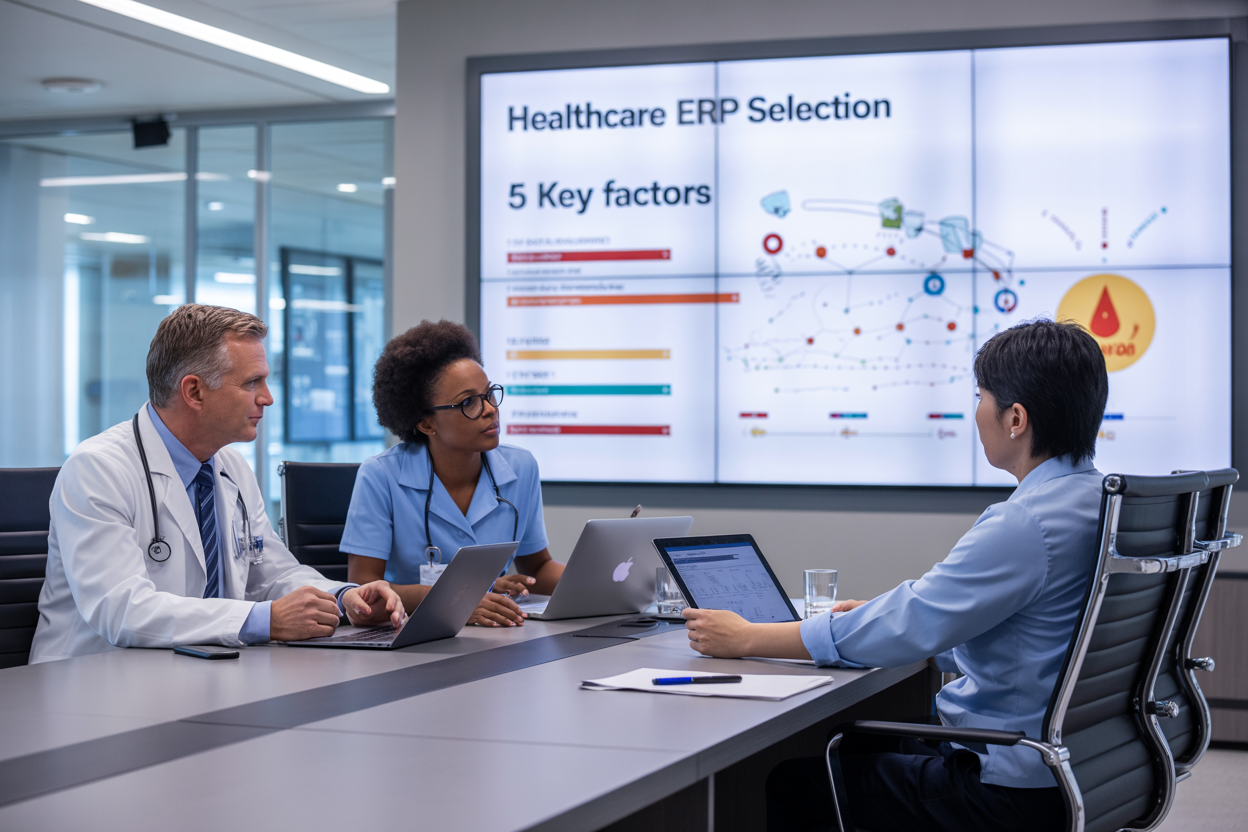
Healthcare organizations face countless daily decisions, but choosing the right ERP system ranks among the most critical. The five factors we’ve explored – understanding your specific needs, evaluating integration capabilities, analyzing total costs, examining vendor expertise, and testing user experience – work together to form a complete picture of what you need. Each factor plays a vital role in ensuring your ERP investment delivers real value to your organization and the patients you serve.
The healthcare landscape keeps evolving, and your ERP system should evolve with it. Take time to thoroughly evaluate each vendor against these criteria, involve your team in the decision-making process, and don’t rush into a commitment. Remember, the cheapest option upfront often becomes the most expensive in the long run. Start by clearly defining your organization’s unique requirements, then use these five factors as your roadmap to find an ERP solution that truly fits your healthcare organization’s needs and goals.