
Introduction
Saudi Arabia is rapidly advancing its digital economy under Vision 2030, and one of the most important regulatory frameworks businesses must follow is ZATCA compliance. Whether you are a small business, SME, or large enterprise, understanding VAT regulations and e-invoicing requirements is now essential for operating legally in the Kingdom.
The Zakat, Tax and Customs Authority (ZATCA) has introduced strict tax rules and a mandatory e-invoicing system (Fatoora) to improve transparency, reduce tax fraud, and modernize financial operations.
For businesses, this shift is not just a legal requirement; it is a complete transformation of how invoices, taxes, and financial records are managed.
This is where modern ERP systems like UniERP play a critical role in simplifying compliance, automating processes, and ensuring businesses stay aligned with ZATCA regulations.
What is ZATCA?
Tax, ZATCA (Zakat, Tax, and Customs Authority) is the official government authority in Saudi Arabia responsible for the following:
- Managing tax systems (including VAT and excise tax)
- Collecting Zakat from eligible businesses
- Regulating customs and import/export operations
- Enforcing tax compliance and audits
- Implementing electronic invoicing systems
ZATCA was formed as part of Saudi Arabia’s efforts to unify tax administration and improve efficiency in financial governance.
Its main objective is to ensure transparency, compliance, and digital transformation in all financial transactions across the country.
Understanding VAT in Saudi Arabia
Value Added Tax (VAT) is a consumption tax applied to goods and services at each stage of the supply chain.
Key VAT points in Saudi Arabia:
- Standard VAT rate: 15%
- Businesses must register for VAT if they meet the threshold defined by ZATCA
- VAT is charged on most goods and services
- Businesses must file regular VAT returns with ZATCA
VAT obligations include:
- Charging VAT on sales invoices
- Paying VAT on purchases
- Submitting VAT returns monthly or quarterly
- Maintaining accurate financial records
Failure to comply with VAT regulations can result in penalties, audits, and legal consequences.
What is ZATCA E-Invoicing (Fatoora)?
One of the biggest reforms introduced by ZATCA is the Fatoora e-invoicing system, which requires businesses to issue invoices electronically instead of paper-based or manually generated invoices.
Purpose of e-invoicing:
- Reduce tax fraud and manipulation
- Improve transparency in transactions
- Standardize invoice formats across all businesses
- Enable real-time reporting and monitoring
Phases of ZATCA E-Invoicing
Phase 1: Generation Phase
In this phase, businesses must:
- Generate invoices electronically
- Ensure invoices include required fields
- Store invoices in digital format
- Avoid handwritten or altered invoices
Phase 2: Integration Phase
This is the advanced phase where businesses must:
- Integrate their systems with ZATCA platform
- Send invoices directly to ZATCA for validation
- Ensure real-time compliance checks
- Use standardized API integrations
This phase requires robust ERP or accounting software that can handle automation and compliance seamlessly.
ZATCA Invoice Requirements
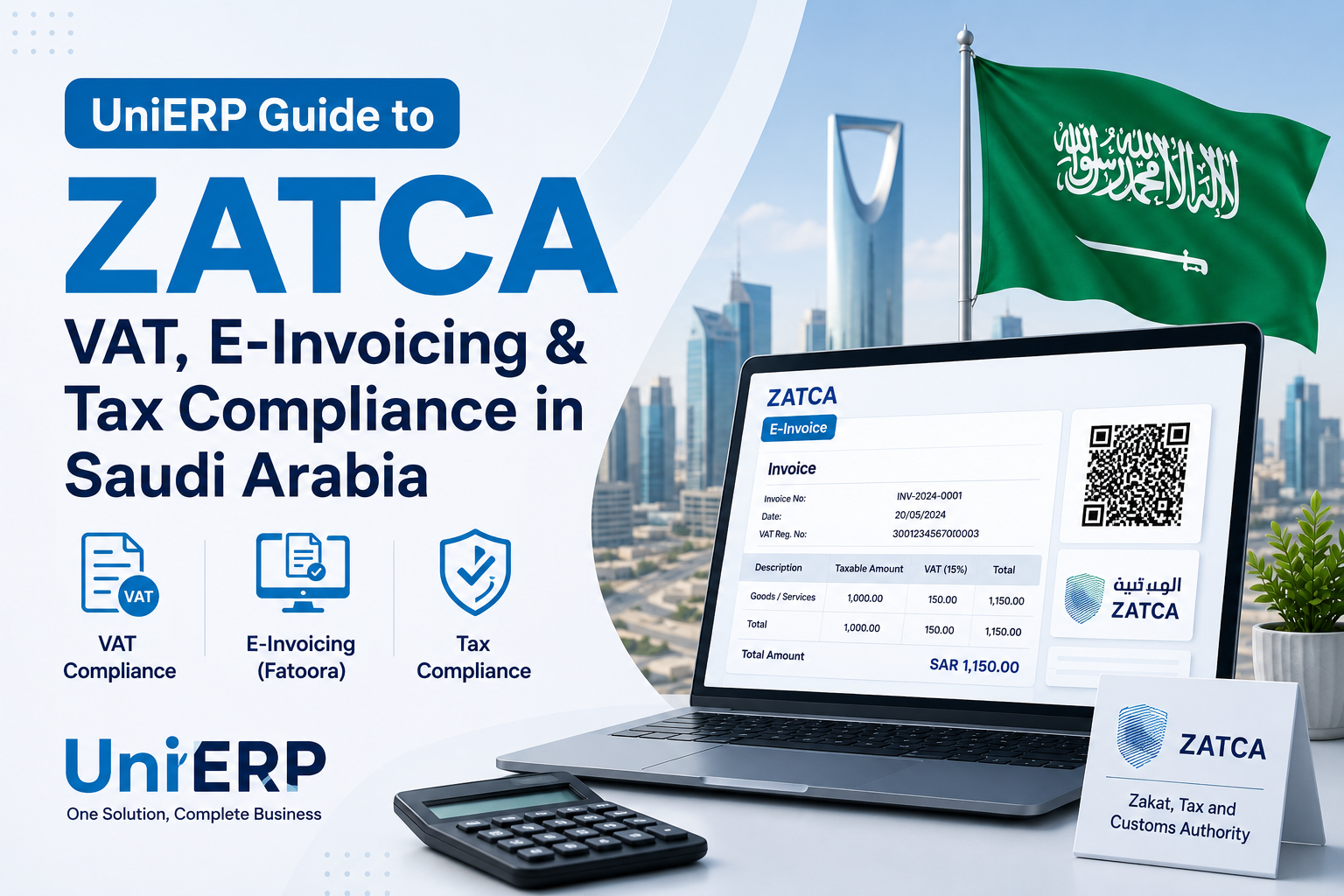
Every invoice issued under ZATCA regulations must include:
- Seller name and address
- VAT registration number
- Invoice number and date
- Product/service description
- VAT amount and taxable amount
- Total invoice value
- QR code (for simplified tax invoices)
These requirements ensure that every transaction is traceable and verifiable by authorities.
Challenges Businesses Face with ZATCA Compliance
Many businesses in Saudi Arabia struggle with compliance due to:
1. Manual Processes
Traditional accounting methods increase the risk of human error.
2. VAT Calculation Complexity
Incorrect VAT calculations can lead to penalties and financial loss.
3. System Integration Issues
Many businesses use outdated systems that cannot integrate with ZATCA requirements.
4. Lack of Real-Time Reporting
Without automation, reporting becomes slow and inefficient.
5. Compliance Monitoring
Keeping up with regulatory updates can be difficult without proper systems.
How ERP Systems Help with ZATCA Compliance
Modern ERP systems solve these challenges by automating key financial processes.
Key ERP benefits:
- Automatic VAT calculation
- ZATCA-compliant invoice generation
- QR code creation for invoices
- Secure digital invoice storage
- Real-time reporting and analytics
- Integration with ZATCA systems
- Reduced manual errors and duplication
ERP systems act as a central hub for all financial, inventory, and sales operations.
UniERP Solution for ZATCA Compliance
UniERP is designed to help businesses simplify complex financial operations and ensure full compliance with ZATCA regulations.
UniERP features include:
- Automated VAT management
- ZATCA-compliant e-invoice generation
- Integration-ready architecture for Phase 2 compliance
- Real-time financial reporting
- Inventory and sales tracking
- Secure cloud-based invoice storage
- Multi-user business management system
UniERP ensures that businesses can focus on growth while staying fully compliant with Saudi tax laws.
Benefits of Using UniERP for ZATCA Compliance
Implementing UniERP provides several advantages:
1. Faster Compliance
Automated processes reduce time spent on manual reporting.
2. Improved Accuracy
Eliminates human errors in VAT and invoice calculations.
3. Cost Efficiency
Reduces administrative workload and operational costs.
4. Better Transparency
Provides clear financial records for audits and reporting.
5. Scalability
Supports business growth across multiple locations and departments.
6. Regulatory Readiness
Ensures businesses stay updated with ZATCA requirements.
Why ZATCA Compliance Matters for Businesses
ZATCA compliance is not optional; it is a legal requirement in Saudi Arabia.
to the following:to the following:to the following: Non-compliance can lead to the following:
- Heavy fines and penalties
- Business disruptions
- Legal action
- Loss of business reputation
On the other hand, compliance improves:
- Financial transparency
- Customer trust
- Business credibility
- Operational efficiency
Future of Digital Taxation in Saudi Arabia
Saudi Arabia is moving toward a fully digital tax ecosystem. With increasing automation and integration, businesses will rely more on ERP systems and cloud-based solutions.
following: include the following: Future trends include the following:
AI-based tax reporting
Real-time invoice validation
Advanced fraud detection systems
Full digital financial ecosystems
Businesses that adopt ERP solutions early will have a strong competitive advantage.
Conclusion
ZATCA is a major step toward digital transformation in Saudi Arabia’s tax system. With strict VAT rules and mandatory e-invoicing requirements, businesses must adapt quickly to remain compliant.
Manual processes are no longer sufficient in today’s regulatory environment. Implementing a modern ERP system like UniERP helps businesses automate VAT management, generate compliant invoices, and ensure full alignment with ZATCA regulations.
By adopting UniERP, businesses not only achieve compliance but also improve efficiency, accuracy, and long-term scalability.
Staying compliant is not just about following rules—it is about building a smarter, more transparent, and future-ready business.