Ask most construction and engineering firms where their margins go, and you’ll hear the usual suspects: material price hikes, labor shortages, weather delays.Those are real. But they’re not the biggest leak.The bigger leak is quieter. It’s the gap between what a project actually costs and what your spreadsheets say it costs a gap that opens the moment your BOQs, site purchases, billing, and project ledgers stop talking to each other.
The problem isn’t effort. It’s disconnection.
Most construction and EPC (Engineering, Procurement, Construction) companies aren’t short on hard work. Site teams are stretched thin, project managers are juggling five things at once, and finance is closing books based on numbers that were accurate three weeks ago.
Here’s what that disconnection usually looks like in practice:
- A Bill of Quantities (BOQ) built in one file, tracked nowhere else
- Site purchases logged on paper, entered into accounting days later
- Project costs reconciled manually, often after the invoice is already sent
- Profitability numbers that project leads and finance leadership see differently, because they’re pulling from different sources
None of this is anyone’s fault. It’s what happens when a business scales faster than its systems do.
What this actually costs you
When BOQs, procurement, and billing live in separate systems, three things quietly happen:
1. You lose real-time visibility into project profitability. By the time cost overruns show up in a report, the money’s already spent.
2. Site purchases and paperwork fall out of sync. Someone buys materials on-site, and finance finds out about it during month-end reconciliation not before.
3. Decisions get made on outdated numbers. Bidding on the next project, allocating resources, approving a change order all of it depends on knowing your current numbers, not last month’s.
This is the pattern we hear most often from architecture, construction, and engineering firms before they bring their operations into one system.
What changes when it’s all connected
We recently worked with Archnotion – Architecture & Construction, and their founder and principal architect, Farman Ullah, described the shift plainly:
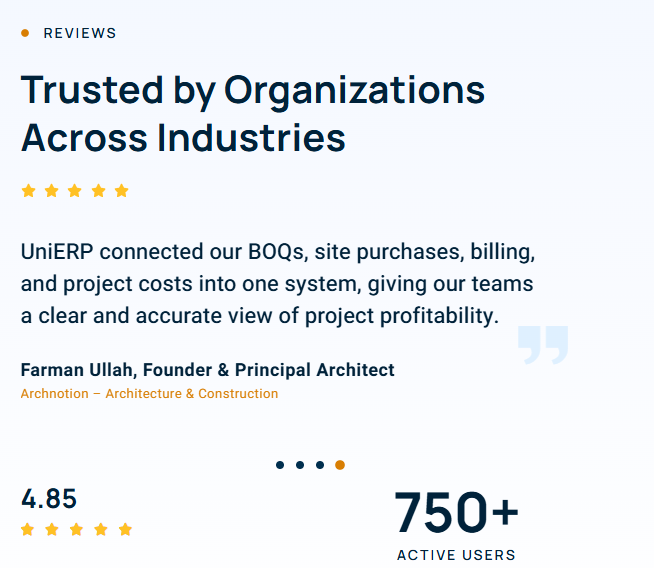
UniERP connected our BOQs, site purchases, billing, and project costs into one system, giving our teams a clear and accurate view of project profitability.
That’s the entire point. Not more dashboards. Not more software to learn. Just one accurate picture of what a project is actually costing, updated as it happens not reconstructed after the fact.
Why this matters more in construction than almost anywhere else
Construction and EPC projects are inherently complex multiple sites, multiple vendors, long timelines, and a dozen moving cost centers running at once. That complexity is exactly why generic, templated software struggles here. It wasn’t built for how construction actually runs; it asks construction to run its way instead.
UniERP was built around the opposite idea: the system should adapt to how your projects actually work not the other way around. For a construction or engineering firm, that means your BOQs, procurement, site activity, and financial reporting sit in one place, reflecting reality in real time instead of catching up to it weeks later.
What this looks like day to day
- BOQ tracking tied directly to actual project costs, not a static reference document
- Site purchases logged and reflected in financials without manual re-entry
- Real-time project cost control, so overruns are visible while there’s still time to act
- One accurate profitability view, shared by project leads and finance alike
None of this requires your teams to change how they work on-site. It requires the system behind them to finally keep up.
Construction margins aren’t usually lost to one big mistake. They’re lost gradually, in the space between systems that don’t talk to each other. Closing that gap doesn’t require more oversight or more reporting — it requires one connected system that shows you the truth as it happens.
That’s what “clarity arriving calmly” actually looks like on a job site.
Want to see what a connected view of your projects could look like? Talk to us or try a free demo.